
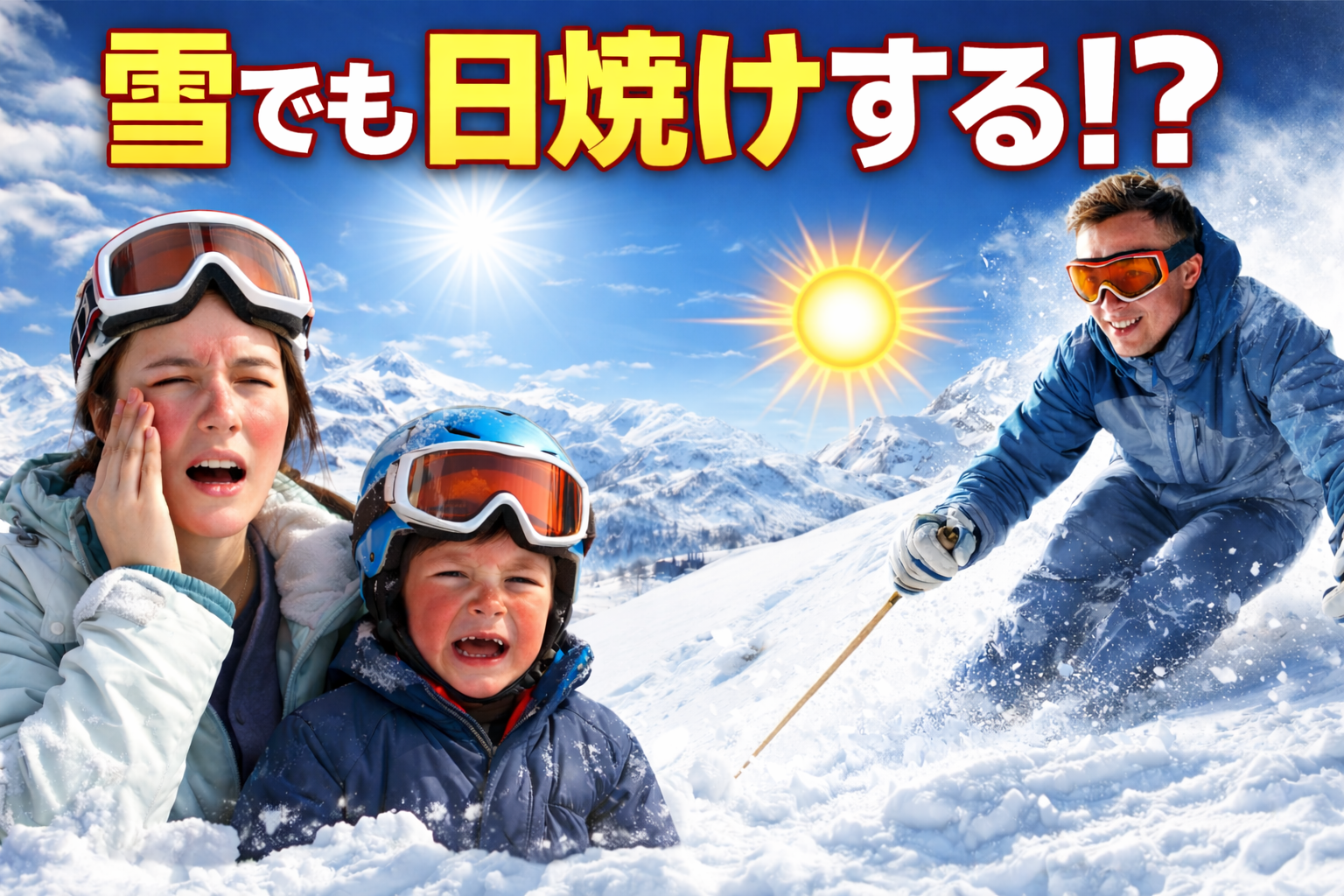
1. Why do we get sunburned even in the snow?
① UV rays have nothing to do with temperature
The cause of sunburn is ultraviolet (UV) rays. The amount of UV rays is determined not by the temperature, but by
- Sun altitude (season and time of day)
- elevation
- Cloud amount
- Ground reflectivity
It depends on:
In other words, even if it's cold, if it's sunny, UV rays are still shining down
② Snow strongly reflects ultraviolet rays
Normally, the ground reflects only about 10% of ultraviolet rays. However, snow is said to reflect around 80% of ultraviolet rays
In other words, in the snowy mountains,
- Direct UV rays from above
- UV rays reflected from the ground (snow)
This will be a double attack
Therefore, it is easy to get sunburned on the lower part of the face (chin, under the nose, under the eyes)
3. The higher the altitude, the stronger the ultraviolet rays
It is said that for every 1000m increase in altitude, UV rays increase by approximately 10-12%
Ski resorts are often located at altitudes of 1,000 to 2,000 meters, so the amount of UV rays is much stronger than at sea level
On the slopes of Hokkaido, Tohoku, and Nagano, you may be exposed to UV rays that are equal to or even greater than those found at the beach in midsummer
4. It's easy to let your guard down in winter
- Don't sweat
- It's not hot
- The sunlight feels soft
This "weak perceived effect" can lead to complacency.
However, ultraviolet rays are still causing significant damage to the skin.
2. Characteristics of snow burns
Sunburn caused by snow (also known as "snow tan") has slightly different characteristics from normal sunburn
① Only the face burns easily
Although the body is covered in winter clothing,
- face
- neck
- ear
- lips
These are the areas that are most easily exposed and tend to burn the most
Goggle tans are especially common when skiing or snowboarding
② Eyes are also damaged
Ultraviolet rays also affect the eyes.
In snowy mountains, you may develop **snow blindness (ultraviolet keratitis)**.
Symptoms include:
- eye pain
- Hyperemia
- Tears won't stop
- rumbling sensation
Goggles and UV-blocking sunglasses are essential
3. Chapped lips
The lips have thin skin and are easily damaged by UV rays.
Dryness combined with UV exposure can cause cracking and peeling.
3. How much UV radiation is there in winter?
"There is less UV rays in winter" is half right and half wrong
Certainly, the amount of UV radiation is less than in the middle of summer.
However,
- clear sky
- High altitude
- Snow reflection
When these conditions are combined, the UV rays can be stronger than you might experience
March and April are particularly critical months.
Even though temperatures may be low, UV radiation levels rise to spring-to-early-summer levels.
comment