
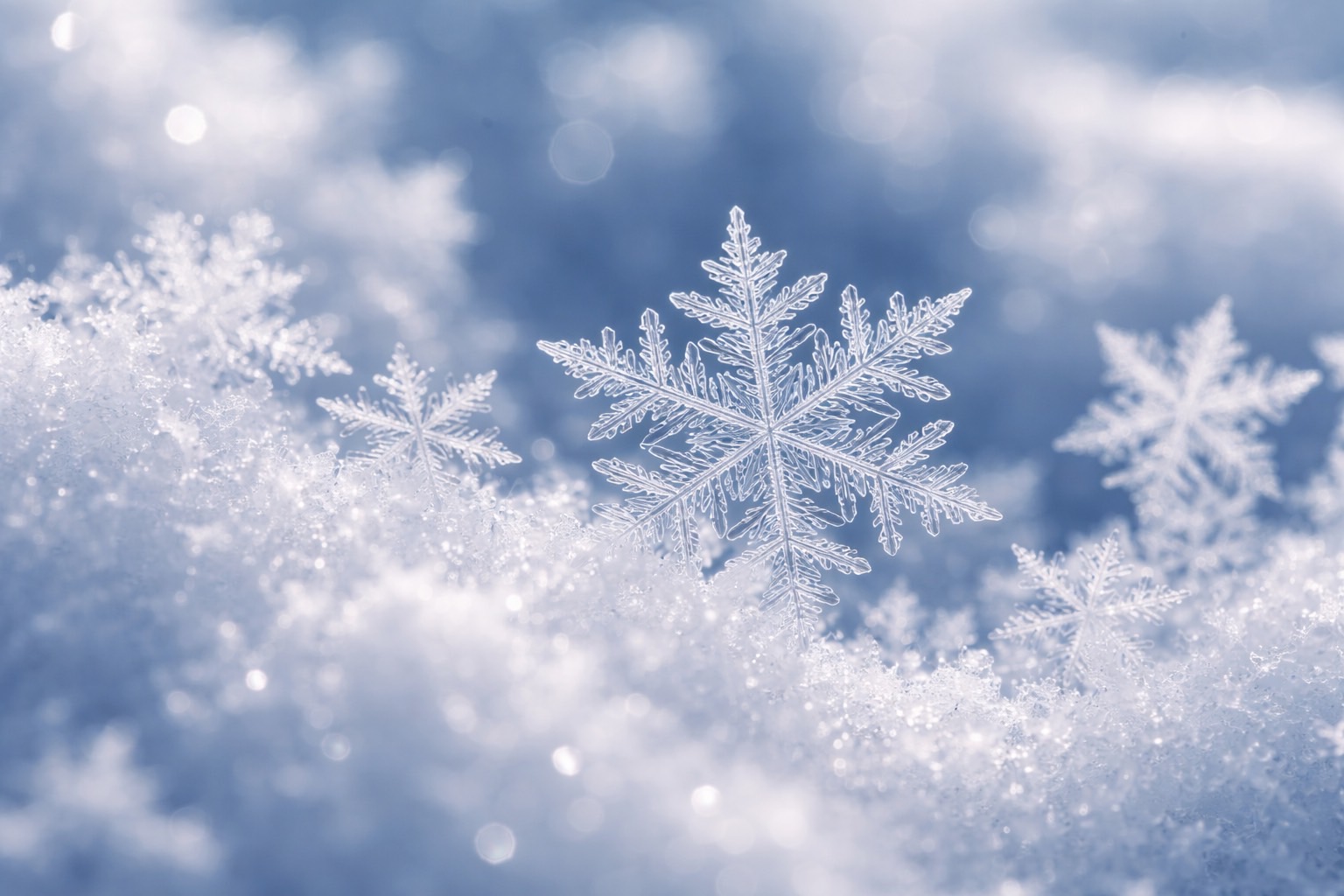
In winter, snow falls from the sky. The snow covers the ground, making it completely white. However, if you think about it, snow is actually frozen water. Water and ice are transparent, so why does snow appear white?
To understand this question, we need to understand the properties of light, the structure of ice, and the shape of snow crystals. Here, we will explain in detail from a scientific perspective why snow appears white
⸻
What is snow anyway?
Snow is a collection of ice crystals formed when water vapor in the air freezes
Snow is formed in clouds through the following process:
1. Water vapor cools and turns into ice crystals.
2. The crystals grow into a hexagonal shape.
3. The crystals stick together to form snowflakes.
4. They become heavy and fall to the ground.
The snow crystals that form at this point basically have a symmetrical hexagonal structure, which is due to the bonding structure of water molecules
Each snowflake is made of transparent ice, which means that it is essentially a transparent substance
So why does snow look white when it gathers together?
⸻
The Basics of Light - How Do We See Colors?
First, let's understand how we see color
Sunlight appears white at first glance, but it is actually a mixture of light of various colors
These are lights with different wavelengths, such as red, orange, yellow, green, blue, indigo, and violet
This phenomenon is called dispersion of light, and when light passes through a prism it splits into the colors of the rainbow
The color of an object is determined by the following three factors:
1. Absorption of light
2. Reflection of light
3. Scattering of light
For example:
• Leaves → Reflect green light
• Charcoal → Almost completely absorbs light (black)
• Paper → Reflects a lot of light (white)
In other words, an object that appears white
is an object that reflects all colors of light equally.
Snow also fits this criteria
⸻
The main reason why snow looks white is because of light scattering
The reason snow appears white
is due to the scattering of light.
When light hits snow, it bounces off the ice crystals in the snow in all directions
This phenomenon is called light scattering
Here's what happens inside the snow:
Sunlight
↓
Hits a snowflake
↓
Reflects
↓
Hits a neighboring snowflake
↓
Reflects again
↓
Hits yet another snowflake
In other words , light is reflected dozens of times in the snow
As a result
, • All colors of light are reflected equally,
• and it appears white to our eyes.
This is how it works
⸻
Why is snow white even though ice is transparent?
This is the most mysterious point
Ice is transparent.
Water is transparent.
But snow is white
The reason is
The presence of air
Snow is not just ice
Ice + Air
is
The structure of the snow is actually quite loose
It is said that more than 90% of its volume is air
The presence of air between ice crystals results in:
• Ice → Refraction
• Air → Refraction
• Boundary → Reflection
is repeated
At this point, it is important
Refraction
and
reflection
.
Light changes direction at the boundary between different materials
In the snow
Ice ↔ Air
Ice ↔ Air
Ice ↔ Air
There are thousands of such boundaries
This causes light to scatter in a complex way
This is why snow appears white
⸻
Why fresh snow looks especially white
Freshly fallen snow looks especially white
This is because the crystals have a beautiful shape
Characteristics of fresh snow
: • Unbroken crystals
• Contains a lot of air
• Fine surface
This results in strong light scattering
In other words
The more scattering there is, the whiter it appears
That is what it means
⸻
When snow loses its whiteness
In fact, snow isn't always pure white
The color changes depending on the conditions
① Melted snow
When snow melts, it becomes water
Since water is transparent,
the whiteness disappears.
This is because there is less air in the snow
⸻
②Compressed snow
Snow at ski resorts is compressed
Because there is less air
, light scattering is reduced
, and it appears slightly grayish.
There are times when this happens
⸻
③Dirty snow
The snow on the roads turns black
This is
• soil
• exhaust fumes
• garbage
This is because they absorb light
⸻
Why snow sometimes looks blue
When a lot of snow accumulates, it can appear blue
For example:
• Glaciers
• Snow caves
• Deep snow
And so on
this is
Rayleigh scattering
is involved.
Inside ice:
• Red light → easily absorbed
• Blue light → easily scattered
Therefore, it may appear bluish
The same principle is why glaciers appear blue
⸻
- Snowflake Shape
Snowflakes actually come in countless shapes
This varies with temperature and humidity
One Japanese physicist famous for his research on snow is Ukichiro Nakaya
He is famous for his work on artificial snow
"Snow is a letter sent from heaven"
He left behind the following words
Research has revealed
: • Plate-like crystals
• Needle-like crystals
• Dendritic crystals
I found that there are many different forms
But in any case, basically
Light-scattering structure
It appears white because it has
⸻
Why snow is so dazzling
Being outside on a snowy day can be very dazzling
This is snow
Very high reflectivity
To have
The reflectivity of snow is
80〜90%
It is said that..
This means it reflects most of the sunlight
Therefore, in the snowy mountains
Snow blindness
(keratitis caused by ultraviolet light)
This can sometimes happen
This is why you need sunglasses when skiing or mountain climbing
⸻
summary
Here's a summary of why snow appears white:
1. Snow is a collection of ice crystals.
2. There's a large amount of air between the crystals.
3. Light reflects multiple times at the boundary between ice and air.
4. Light is scattered in all directions.
5. All colors of light are reflected equally.
As a result, in our eyes
Snow looks white
That's why
In other words, the whiteness of snow
A natural phenomenon caused by light scattering
We can say that
The transparent ice gathers together, mixes with the air, and scatters the sunlight, creating the beautiful snowy scenery
comment